
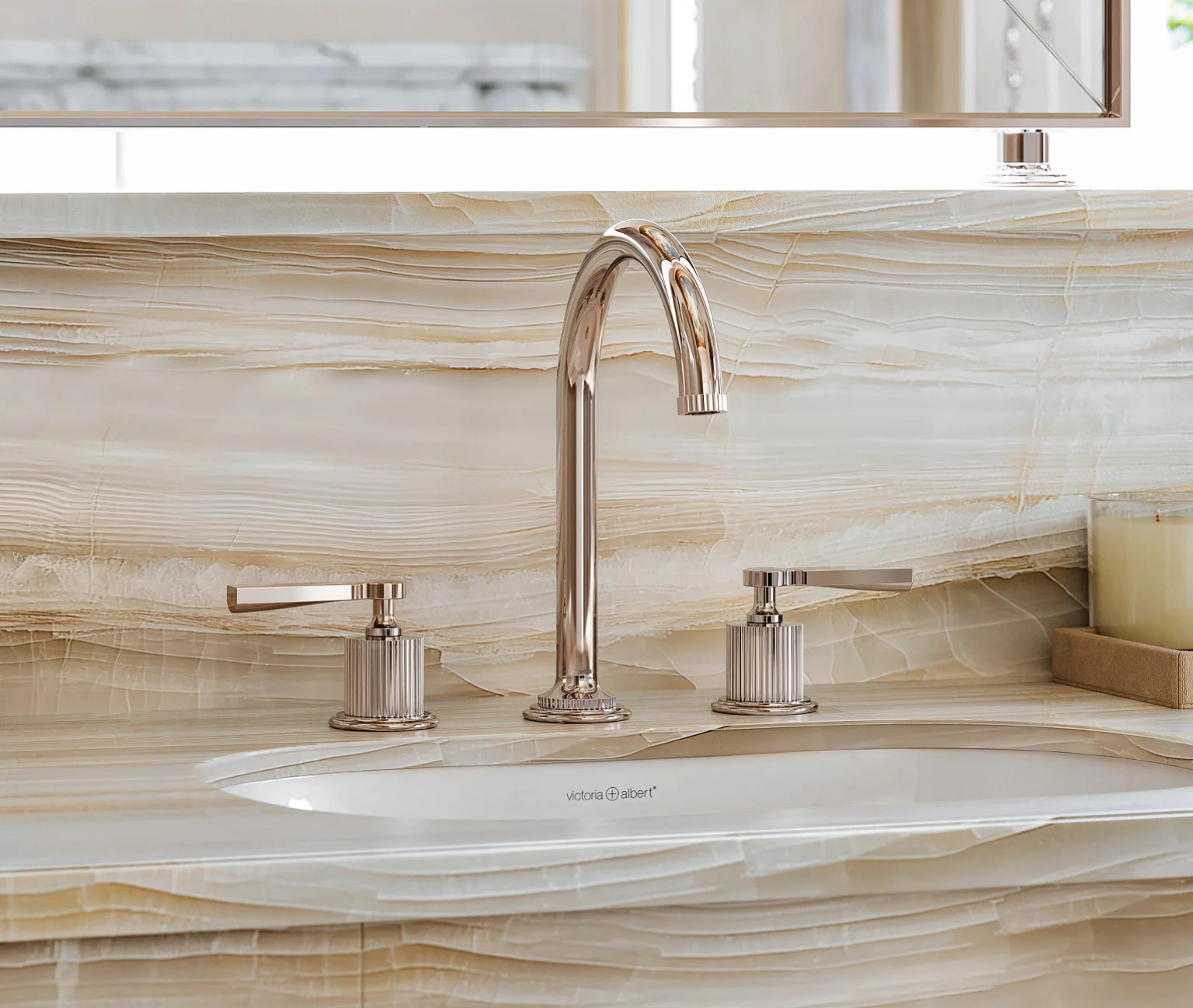
Bathroom Faucet Buying Guide: Types, Sizes, Finishes & Features
We Make Luxury AffordableSeptember 3, 2026
Choosing a bathroom faucet is about more than picking a finish you like. The right faucet needs to fit your sink, work with your plumbing, provide the right amount of clearance, and suit how you use the bathroom.
Whether you’re replacing an existing faucet or designing a new bathroom, understanding bathroom faucet types, sizes, and features can help you avoid compatibility issues and choose a fixture you’ll be happy with for years.
This bathroom faucet buying guide covers the key things to consider before you buy, from mounting styles and dimensions to handles, finishes, water-saving features, and installation.
How to Choose the Right Bathroom Faucet
Start with function and compatibility, then narrow down your choices based on style.
Before choosing a faucet, consider these factors:
| What to check | Why it matters |
| Faucet type | Determines how the faucet mounts and how it operates |
| Number of sink holes | Your faucet needs to match the existing configuration |
| Faucet height | Ensures adequate clearance above the sink |
| Spout reach | Helps the water land in the right part of the basin |
| Finish | Affects the overall appearance and maintenance |
| Handle style | Determines how the faucet is operated |
| Water pressure | Some faucets may require specific pressure conditions |
| Features | Can improve convenience, efficiency, or accessibility |
| Installation | Some configurations require more plumbing work |
Tip: If you’re replacing a faucet, measure your existing setup before shopping. The number and spacing of holes can immediately narrow down which faucets will work.
Bathroom Faucet Types
One of the first decisions is choosing the right faucet configuration. Different bathroom faucet types are designed for different sinks, countertops, and bathroom layouts.
Single-Hole Bathroom Faucets
A single-hole faucet combines the spout and controls into one compact unit and installs through a single opening.
Best for:
- Modern bathrooms
- Small vanities
- Compact powder rooms
- Sinks with one faucet hole
Single-hole faucets are popular because they have a clean appearance and generally require less counter space.
They are especially convenient when paired with a single-handle design, allowing you to control water flow and temperature with one lever.
Centerset Bathroom Faucets
Centerset faucets are designed for sinks or countertops with three holes arranged closely together. The spout and handles are typically mounted on a shared base.
Best for:
- Standard bathroom vanities
- Traditional and transitional bathrooms
- Compact countertop layouts
Centerset designs can be a practical choice when replacing an existing three-hole faucet because they can work with the existing configuration.
Always check the manufacturer’s specifications before buying, as dimensions and mounting requirements can vary between models.
Widespread Bathroom Faucets
Widespread faucets have separate hot and cold handles and a separate spout. The components are installed individually, giving you more flexibility over their placement.
Best for:
- Larger bathroom vanities
- Traditional or luxury bathrooms
- Custom countertop installations
- Homeowners who want a more spacious, decorative appearance
Because the components are separate, widespread faucets can create a more customized look than compact faucet configurations.
For example, Bliss Bath & Kitchen carries a range of premium widespread designs, including options from ROHL and Perrin & Rowe.
Wall-Mount Bathroom Faucets
Wall-mounted faucets are installed into the wall rather than directly onto the sink or countertop.
They can create a clean, minimalist appearance and are particularly useful with certain vessel or countertop sink designs.
Before choosing one, check:
- Wall plumbing requirements
- Faucet spout reach
- Installation height
- Sink dimensions
- Water flow position
Wall-mounted faucets generally require more planning than deck-mounted models because the plumbing connections are located behind the finished wall.
Vessel Sink Faucets
Vessel sinks sit above the countertop, so they typically require a taller faucet or an appropriately positioned wall-mounted faucet.
The important consideration is clearance.
A faucet that is too short may not reach over the vessel. A faucet that is excessively tall or has an unsuitable spout angle may cause unnecessary splashing.
Measure the sink height and compare it with the faucet’s spout height and reach before purchasing.
Touchless Bathroom Faucets
Touchless faucets use sensors to activate water without requiring you to touch a handle.
They can be useful in busy family bathrooms, guest bathrooms, and spaces where hands-free operation is a priority.
However, consider the power requirements, sensor placement, maintenance, and installation requirements before choosing this type.
Bathroom Faucet Sizes: What You Need to Know
Faucet size isn’t simply about whether a faucet looks “big” or “small.” The dimensions need to work with your sink and countertop.
The most important measurements are:
- Faucet height
- Spout height
- Spout reach
- Faucet width
- Hole spacing
- Clearance around the sink
Faucet Height
Faucet height is the overall vertical dimension of the faucet.
A taller faucet can work well with a vessel sink, while a lower-profile faucet may be better suited to a conventional undermount or drop-in basin.
Don’t choose based on height alone. Consider how the faucet’s spout lines up with the basin.
Spout Reach
Spout reach refers to how far the spout extends over the sink.
Ideally, the water should fall comfortably inside the basin rather than too close to the front, back, or side.
A faucet with too much reach can cause water to land in an awkward position. Too little reach may make the faucet uncomfortable to use.
Faucet Width
Width matters particularly when you’re working with a smaller vanity or backsplash.
Make sure handles can be operated comfortably without hitting:
- The backsplash
- The wall
- A mirror
- Cabinets
- Other bathroom fixtures
Faucet Hole Spacing
Hole configuration is one of the most important compatibility checks.
| Configuration | Typical setup |
| Single-hole | One opening for the faucet |
| Centerset | Three-hole configuration with closely spaced components |
| Widespread | Separate spout and handles with wider spacing |
| Wall-mounted | Faucet attaches to the wall rather than the sink deck |
Always check the actual manufacturer’s dimensions. Terms such as “centerset” or “widespread” describe common configurations, but individual models can have different specifications.
How to Measure for a Bathroom Faucet
Replacing a faucet? Take a few measurements before ordering.
Step 1: Check the Number of Holes
Look underneath or behind your existing faucet to determine whether your sink or countertop has one, two, or three faucet openings.
Step 2: Measure Hole Spacing
For a multi-hole installation, measure from the center of one hole to the center of the other.
Don’t assume that a new faucet will fit simply because it has the same number of holes.
Step 3: Measure Faucet Height
Measure the available space above the sink, especially if you have:
- A mirror
- Shelving
- A medicine cabinet
- A backsplash
- A window
Step 4: Measure Spout Reach
Check the distance from the faucet mounting point to the location where water exits the spout.
The goal is to position the water stream comfortably within the basin.
Step 5: Check Clearance
Make sure the faucet handles can move freely and that the spout doesn’t interfere with the backsplash or other fixtures.
Bathroom Faucet Features to Consider
Once you’ve found a faucet that fits your sink, look at the features that affect everyday use.
Single-Handle vs. Two-Handle Faucets
Single-handle faucets use one lever to control flow and temperature.
Two-handle faucets have separate controls for hot and cold water.
| Feature | Single handle | Two handle |
| Operation | Simple | Separate hot/cold control |
| Appearance | Often minimalist | Traditional or decorative |
| Space | Compact | Requires more space |
| Temperature adjustment | One control | Two controls |
| Style options | Modern to transitional | Traditional to modern |
The better option depends on your preferences and bathroom design.
Ceramic Disc Cartridges
The cartridge is one of the internal components that controls water flow.
Ceramic disc cartridges are widely used in modern faucets and are valued for smooth operation and durability.
When comparing faucets, don’t focus only on the exterior. Internal components can have a major effect on long-term performance.
Water-Saving Features
If reducing water consumption is important to you, look for faucets designed with efficient flow rates or aerators.
An aerator mixes air with the water stream to create a comfortable flow while using less water than an unrestricted stream.
Check the manufacturer’s specifications for the faucet’s actual flow rate rather than assuming all faucets use the same amount of water.
Faucet Handles
Handle design affects both appearance and usability.
Common options include:
- Lever handles: Simple and easy to operate
- Cross handles: Classic and traditional
- Knob handles: Compact and decorative
- Sensor controls: Hands-free operation
For a busy family bathroom, a simple lever can be particularly convenient.
For a traditional bathroom, cross handles can add a more classic character.
Temperature Control Features
Some faucets offer features designed to make temperature adjustment easier or safer.
Depending on the model, these can include:
- Temperature limiters
- Separate temperature and flow controls
- Thermostatic technology in related bathroom fixtures
Always check the product specifications to understand exactly what a particular faucet includes.
Easy-Clean Features
A faucet is exposed to water, soap, toothpaste, and mineral deposits every day.
Features such as easy-clean aerators and practical finishes can make maintenance easier.
However, no finish is completely maintenance-free. Follow the manufacturer’s cleaning instructions to protect the surface.
Choosing the Right Bathroom Faucet Finish
Finish is one of the easiest ways to change the look of a bathroom.
Popular options include:
| Finish | Design character | Considerations |
| Chrome | Clean and versatile | Works with many styles |
| Polished nickel | Warm and refined | Suits traditional and transitional spaces |
| Brushed nickel | Soft and understated | Helps create a subtle look |
| Matte black | Modern and bold | Creates strong contrast |
| Brushed gold | Warm and decorative | Works well as an accent |
| Unlacquered brass | Classic and evolving | Develops a natural patina over time |
Don’t choose a finish based on the faucet alone.
Consider matching or coordinating it with your:
- Shower fixtures
- Cabinet hardware
- Towel bars
- Lighting
- Door hardware
- Other bathroom accessories
For shoppers looking for premium finish options, brands such as Riobel offer bathroom faucet designs across a range of styles and finishes. Bliss Bath & Kitchen’s Riobel selection includes single-hole and wall-mount options among its bathroom faucet offerings.
Bathroom Faucet Installation: What to Check Before Buying
The easiest faucet to install is usually one that matches your existing sink and plumbing configuration.
Before ordering, check:
- Number of faucet holes
- Hole spacing
- Supply connections
- Countertop thickness
- Faucet dimensions
- Water pressure requirements
- Manufacturer installation requirements
Wall-mounted faucets can require additional planning because plumbing is installed inside the wall.
If you’re doing a renovation, it’s best to select the faucet before finalizing the plumbing rough-in.
For plumbing work, follow local requirements and use a qualified professional where necessary. Bunnings and other bathroom guidance sources similarly recommend considering existing plumbing, installation location, and water pressure when selecting bathroom tapware.
How Much Should You Spend on a Bathroom Faucet?
Bathroom faucets are available at a wide range of price points.
Instead of choosing purely by price, consider what you’re getting for the money.
Budget Faucets
Usually focus on basic functionality and simple designs.
Mid-Range Faucets
Often provide more choices in:
- Design
- Finish
- Handle configuration
- Internal components
- Warranty coverage
Premium Faucets
Premium faucets may emphasize:
- Refined design
- Specialty finishes
- Materials and construction
- Detailed engineering
- Brand heritage
- Longer-term support and warranty
The most expensive faucet isn’t automatically the best choice. The right faucet is one that fits your sink, meets your needs, and provides the features and quality you value.
Common Bathroom Faucet Buying Mistakes
1. Buying Before Measuring
A beautiful faucet is useless if it doesn’t fit your sink.
2. Ignoring Hole Configuration
Always check whether you need a single-hole, centerset, widespread, or wall-mounted faucet.
3. Choosing the Wrong Spout Reach
The water should land comfortably inside the basin.
4. Choosing Height Based Only on Appearance
A tall faucet isn’t automatically better. Make sure it works with your sink and surrounding space.
5. Choosing a Finish Without Considering the Rest of the Bathroom
Coordinate the faucet with other hardware for a more cohesive design.
6. Forgetting Water Pressure
Check the faucet’s requirements against your home’s plumbing system.
7. Focusing Only on Exterior Design
Look at the internal cartridge, flow rate, warranty, installation requirements, and overall specifications too.
Bathroom Faucet Buying Checklist
Before you click Buy, run through this checklist:
Fit
- Number of holes checked
- Hole spacing measured
- Faucet height checked
- Spout reach checked
- Sink clearance confirmed
Function
- Single or two handles selected
- Water flow requirements checked
- Desired features identified
- Water-saving options considered
Style
- Finish selected
- Faucet style matches the bathroom
- Finish coordinates with other fixtures
Installation
- Plumbing compatibility checked
- Installation requirements reviewed
- Professional installation considered if required
Long-term value
- Cartridge/component quality checked
- Warranty reviewed
- Cleaning requirements understood
Frequently Asked Questions
There isn’t one best type for every bathroom.
A single-hole faucet is a good choice for compact, modern spaces, while centerset faucets work well with many standard three-hole sinks. Widespread faucets offer a more spacious, decorative look, and wall-mounted faucets can be ideal for specific countertop and vessel sink installations.
Start by measuring your sink or countertop’s faucet holes, hole spacing, available clearance, and the distance from the faucet mounting point to the basin.
Then compare those measurements with the manufacturer’s specifications.
No. Bathroom faucets are not universally compatible.
Different faucets require different hole configurations, dimensions, mounting arrangements, and plumbing connections.
It depends on the faucet type.
Single-hole faucets require one opening. Centerset and widespread faucets commonly use multiple openings, while wall-mounted faucets are installed through plumbing in the wall.
Always check the manufacturer’s installation specifications.
A centerset faucet has its components arranged closely together, typically on a shared base.
A widespread faucet has separate handles and spout, allowing greater flexibility in spacing.
A vessel sink generally needs a faucet with enough height and reach to clear the raised basin.
A tall vessel faucet or appropriately positioned wall-mounted faucet can work well. Measure the sink and faucet together before buying.
The answer depends on the finish and the conditions in your bathroom.
Smooth finishes can be relatively easy to wipe clean, while some brushed finishes can make water spots and fingerprints less noticeable.
Always follow the manufacturer’s cleaning instructions.
They can be a good choice if reducing water consumption is a priority.
Look for the faucet’s stated flow rate and any applicable water-efficiency certifications rather than relying only on marketing terms such as “water saving.”
A quality faucet can provide many years of service, but lifespan depends on construction, water quality, frequency of use, maintenance, installation, and the quality of its internal components.
Warranty terms can also provide useful information when comparing products.
They don’t have to match exactly, but coordinating finishes can create a more cohesive bathroom.