Enquire Now
#

Category: Bathroom Products

We Make Luxury Affordable

Pull-Down vs Pull-Out Kitchen Faucets: Which Should You Choose?

#image_title

Choosing the right kitchen faucet can make everyday tasks more convenient while complementing the overall design of your kitchen. Two popular options are pull-down and pull-out kitchen faucets. Both feature an extendable spray head, offering flexibility for washing dishes, rinsing produce and cleaning the sink.

So, when comparing pull-down vs pull-out kitchen faucets, which should you choose? The answer depends on your sink configuration, available countertop space, daily kitchen routines and preferred design.

In this guide, we’ll explain how both faucet styles work, compare their key features and help you select a design that suits your home.

What Is a Pull-Down Kitchen Faucet?

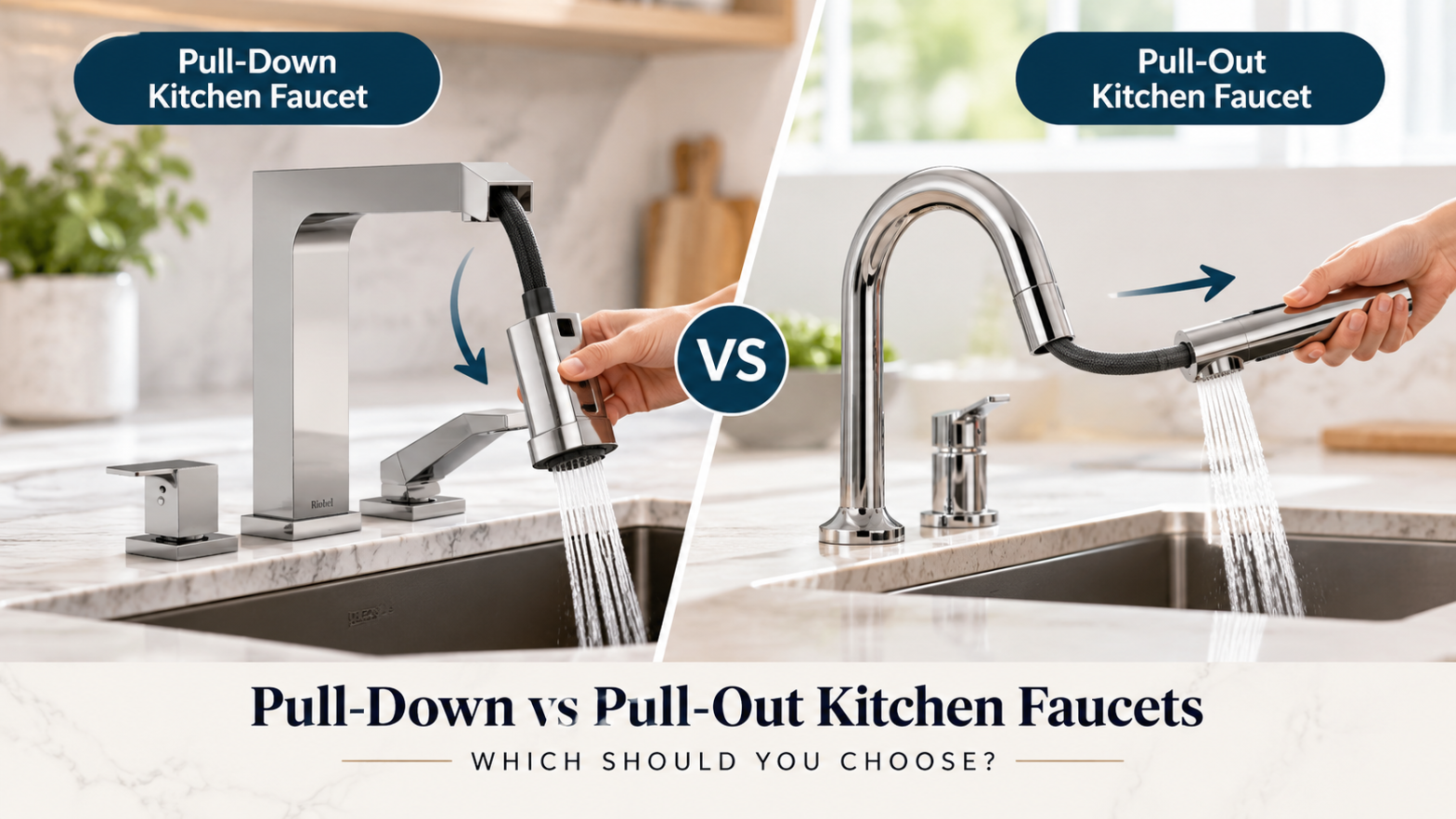
A pull-down kitchen faucet features a spray head that pulls down from the faucet spout towards the sink. Its design typically pairs a high, curved spout with an extendable hose, making it a popular choice for contemporary kitchens.

The downward movement provides convenient access to different areas of the sink, helping with everyday tasks such as rinsing vegetables, filling pots and cleaning dishes.

Key Features of Pull-Down Faucets

  • Convenient rinsing: Direct water towards specific areas of the sink for everyday cleaning tasks.
  • High-arc designs: Create space for washing larger pots, pans and cookware.
  • Modern appearance: Complement contemporary, transitional and minimalist kitchen designs.
  • Versatile spray functions: Many models offer multiple spray settings for different kitchen activities.
  • Coordinated finishes: Available in various finishes to complement sinks, cabinet hardware and other kitchen fixtures.

Pull-down faucets are particularly well suited to homeowners who want a streamlined appearance combined with practical sink functionality.

What Is a Pull-Out Kitchen Faucet?

A pull-out kitchen faucet features a spray head that pulls outward from the spout towards the user. The extended hose allows the spray head to move around the sink and, depending on the model and hose length, reach nearby areas.

This design offers flexibility for kitchens where precise water direction and manoeuvrability are important.

Key Features of Pull-Out Faucets

  • Flexible movement: Direct water where it’s needed across the sink.
  • Compact styling: Many designs feature a shorter or lower-profile spout.
  • Convenient food preparation: Make rinsing produce and filling containers straightforward.
  • Practical cleaning: Help clean different areas of the sink with controlled water direction.
  • Design versatility: Available in traditional, transitional and contemporary styles.

Pull-out faucets are an excellent option for homeowners who value manoeuvrability and a compact faucet profile.

Pull-Down vs Pull-Out Kitchen Faucets: Key Differences

Both styles provide an extendable spray head, but their movement and overall design influence how they fit into your kitchen.

Feature Pull-Down Faucet Pull-Out Faucet
Spray head movement Pulls down towards the sink Pulls outward towards the user
Typical design High-arc, curved spout Often a compact or lower-profile spout
Main advantage Convenient downward rinsing Flexible movement around the sink
Ideal use Washing larger cookware and everyday rinsing Food preparation and targeted cleaning
Design appeal Contemporary and streamlined Compact and versatile
Best selection factor Sink depth and spout height Countertop space and preferred reach

Both options can deliver excellent everyday performance. The most suitable choice depends on how you use your kitchen and the design you want to achieve.

How to Choose the Right Kitchen Faucet for Your Home

1. Consider Your Sink Size and Configuration

Your sink should be one of the first considerations when selecting a faucet. A deeper or wider sink may pair well with a high-arc pull-down model, while a pull-out design can provide convenient manoeuvrability in a variety of sink configurations.

Consider the sink’s depth, width, number of bowls and available clearance before choosing your faucet.

2. Think About Your Daily Kitchen Routine

Consider the tasks you perform most often.

If you regularly wash large pots, baking trays and cookware, a pull-down faucet may suit your routine. If you frequently rinse fresh produce, fill containers or direct water around different areas of the sink, a pull-out faucet can offer the flexibility you need.

Both styles support a range of everyday kitchen activities, so prioritise the features that matter most to you.

3. Check Spray Functions and Hose Reach

Many pull-down and pull-out kitchen faucets offer different spray settings, such as a standard stream and a more concentrated spray.

Check the available functions, hose length and spray-head movement before purchasing. These details help determine how easily the faucet can accommodate your kitchen tasks.

4. Choose a Finish That Complements Your Kitchen

Your faucet is both a functional fitting and an important design detail. Chrome, brushed finishes, polished metals and darker tones can each create a different look.

Coordinate your faucet with your sink, cabinet handles, lighting and other hardware for a cohesive design. If you’re updating fixtures throughout your home, matching the design language with your bathroom faucet styles can help create consistency between spaces.

5. Consider Quality and Long-Term Use

A kitchen faucet is used frequently, making construction quality, reliable operation and ease of maintenance important considerations.

Look at the materials, finish, cartridge design, hose construction and warranty information. Choosing a well-made faucet that suits your household’s needs can support long-term satisfaction.

For homeowners considering premium designs, ROHL kitchen faucets and Perrin & Rowe kitchen faucets are worth considering when comparing styles, finishes and features.

Which Kitchen Faucet Is Best for Your Kitchen?

There isn’t one universal winner. Both designs offer practical features, and either can be an excellent addition to a thoughtfully designed kitchen.

Choose a pull-down kitchen faucet if you prefer a high-arc design, convenient downward rinsing and a contemporary focal point for your sink.

Choose a pull-out kitchen faucet if you prefer a compact profile and value flexible spray-head movement for food preparation and cleaning.

If you’re planning a larger renovation, consider how your faucet will work with the sink, benchtop, cabinetry and overall layout. A design-build professional such as Beck Design Build can be a useful starting point for homeowners researching their wider renovation plans.

You can also consider the broader bathroom and home fixture categories when coordinating design choices across your home.

Find the Right Kitchen Faucet for Your Home

The choice between pull-down and pull-out kitchen faucets comes down to your preferred design, sink configuration and everyday needs. Both styles offer useful functionality, flexible rinsing and a wide range of design options.

Compare available kitchen faucets in Toronto, Canada to find a style that complements your kitchen and supports the way you use it every day.
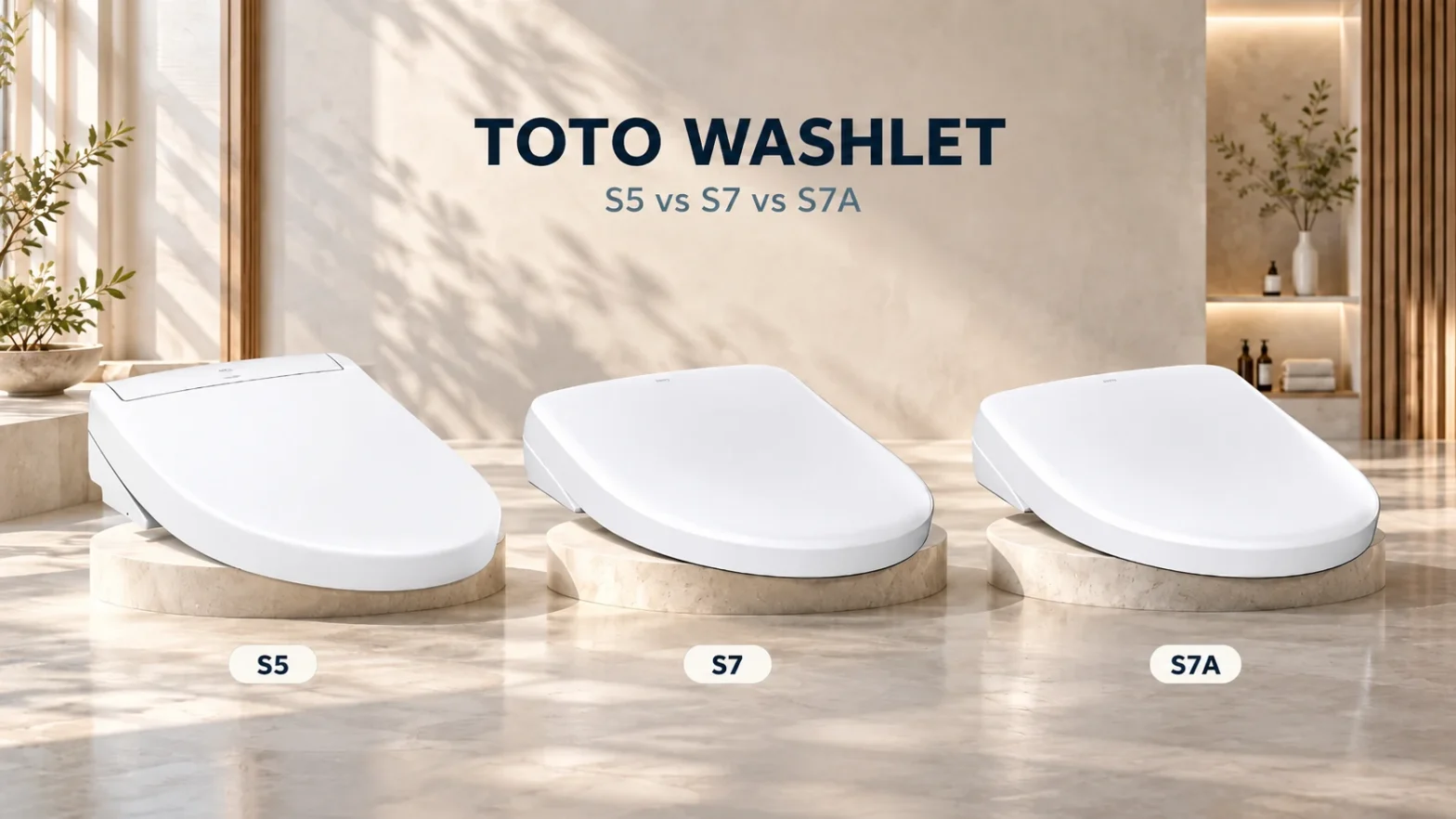
TOTO WASHLET S5 vs S7 vs S7A: Which Bidet Seat Should You Choose?

TOTO WASHLET S5 vs S7 vs S7A: What’s the Real Difference?

TOTO’s S series is the heart of the WASHLET lineup, and the S5, S7 and S7A are the three seats customers ask us about most. At first glance they look almost identical. All three give you endless warm water, a heated seat, a warm air dryer, a deodorizer, EWATER+ and a wireless remote. The differences are in the details: how much you can fine-tune your comfort, how slim each seat sits, how much it automates and how long the warranty runs.

At Bliss Bath and Kitchen, we carry the full TOTO collection, from WASHLET bidet seats to fully integrated NEOREST smart toilets. This guide breaks down the three S-series seats so you can pick the right one for your bathroom without paying for features you won’t use.

Quick Comparison at a Glance

Feature WASHLET S5 WASHLET S7 WASHLET S7A
Model numbers SW3446 (elongated), SW3445 (round) SW4726 (contemporary elongated), SW4724 (classic elongated), SW4725 (round) SW4736 (contemporary elongated), SW4734 (classic elongated), SW4735 (round)
Warm water Instantaneous, endless Instantaneous, endless Instantaneous, endless
Wide Front Cleanse No Yes Yes
Temperature settings (water, seat, dryer) 3 settings 5 settings 5 settings
EWATER+ and PREMIST Yes Yes Yes
Profile Slim (taller at the hinge) Lower-profile design Lower-profile design
Seat sensor Weight-activated seat switch Silent skin-detection sensor Silent skin-detection sensor
Remote Wireless, 4-user memory Multifunction wireless, 4-user memory Multifunction wireless, 4-user memory
Lid SoftClose SoftClose Automatic open/close
Auto flush Not compatible Compatible on select TOTO toilets (kit sold separately) Compatible on select TOTO toilets (kit sold separately)
WASHLET+ compatible Yes Yes Yes
Warranty 1-year limited 2-year limited (residential) 2-year limited (residential)

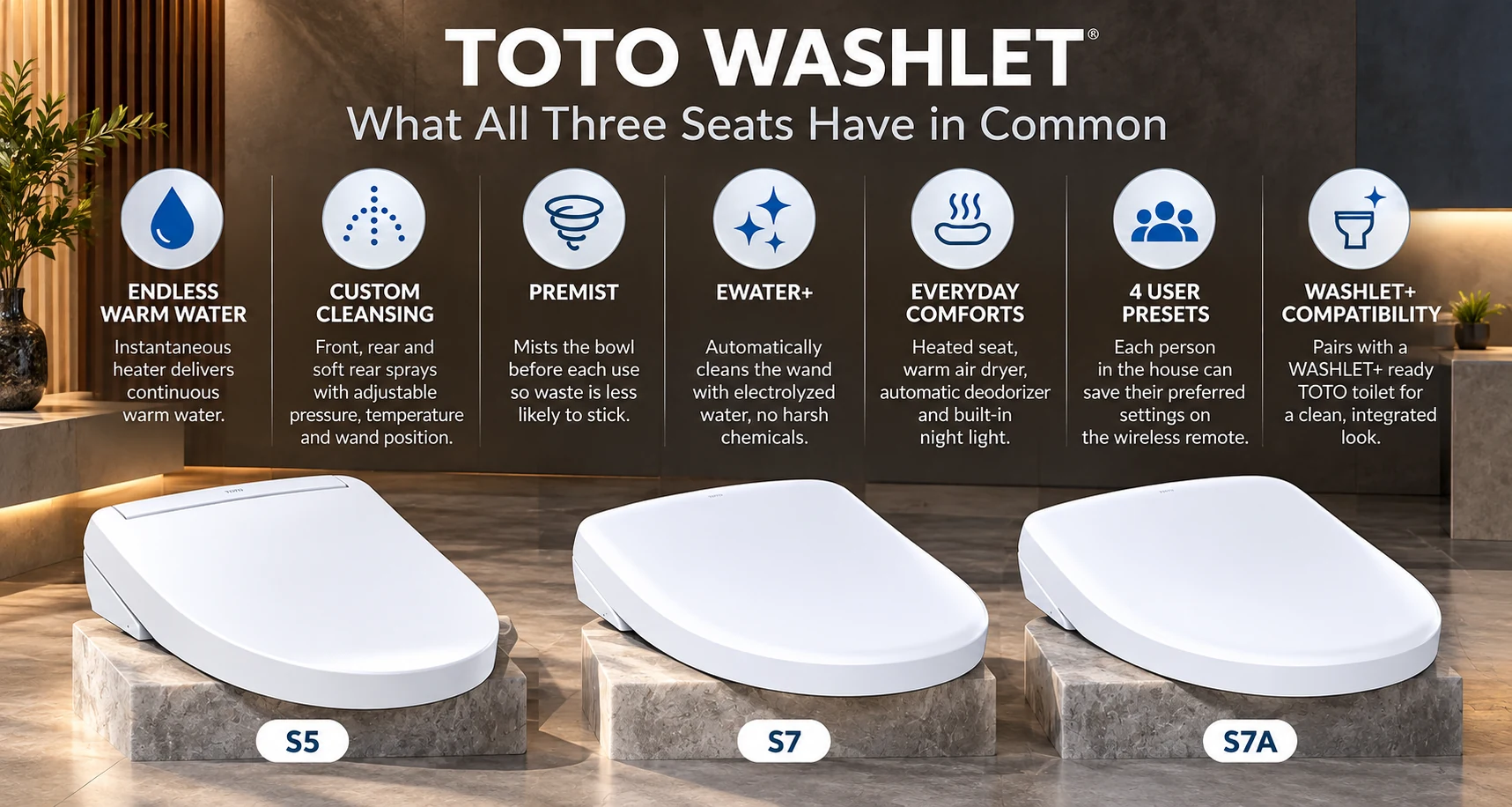
What All Three Seats Have in Common

Before getting into the differences, it helps to know how much you get with any S-series WASHLET. These are all premium bidet seats, and even the S5 is a big step up from a basic model.

TOTO WASHLET S5, S7 and S7A shared features comparison

  • Endless warm water: an instantaneous heater warms water on demand, so it never runs cold, even with back-to-back use.
  • Custom cleansing: front, rear and soft rear sprays, with oscillating and pulsating options and adjustable pressure, temperature and wand position.
  • PREMIST: mists the bowl before each use so waste is less likely to stick.
  • EWATER+: electrolyzed water cleans the wand automatically, with no harsh chemicals.
  • Everyday comforts: a heated seat, warm air dryer, automatic deodorizer and built-in night light.
  • Four user presets: each person in the house can save their preferred settings on the wireless remote.
  • WASHLET+ compatibility: paired with a WASHLET+ ready TOTO toilet, the power cord and water line tuck out of sight.

TOTO WASHLET S5: The Smart Value Pick

The S5 is TOTO’s most accessible remote-controlled S-series seat, and it covers everything most households want from a WASHLET. Its tankless design is noticeably slimmer than the older C5 it replaces, and its rounded corners and streamlined hinge make it easier to wipe down.

Where the S5 saves money is in the finer details. It offers three temperature settings for the water, seat and dryer instead of five, and it doesn’t include Wide Front Cleanse. The seat uses a weight-activated switch in the hinge instead of a skin sensor, and it sits a bit taller at the back. It isn’t compatible with TOTO’s auto flush kit, and it carries a one-year limited warranty. It’s available in both elongated and round versions.

Best for

Guest bathrooms, powder rooms and anyone who wants TOTO quality without the premium price.

TOTO WASHLET S7: The Sweet Spot for Primary Bathrooms

The S7 is where the S series starts to feel truly high-end. The biggest upgrade is comfort control: five temperature settings for the water, seat and dryer let you dial in exactly what you like, and Wide Front Cleanse adds a broader, gentler front spray. EWATER+ keeps the wand and bowl cleaner between uses.

The S7 also looks more refined. Its lower-profile design sits close to the bowl for a nearly integrated appearance, and it comes with TOTO’s multifunction wireless remote. A silent skin-detection sensor replaces the S5’s hinge switch. The S7 can also be paired with TOTO’s optional auto flush kit on select compatible TOTO toilets, and it’s backed by a two-year limited residential warranty. It’s available in contemporary and classic elongated versions, plus a round version. What it doesn’t have is an automatic lid.

Best for

Primary bathrooms and busy family bathrooms, where finer comfort settings, a sleeker look and longer warranty coverage make the biggest difference day to day.

TOTO WASHLET S7A: The Most Automated Option

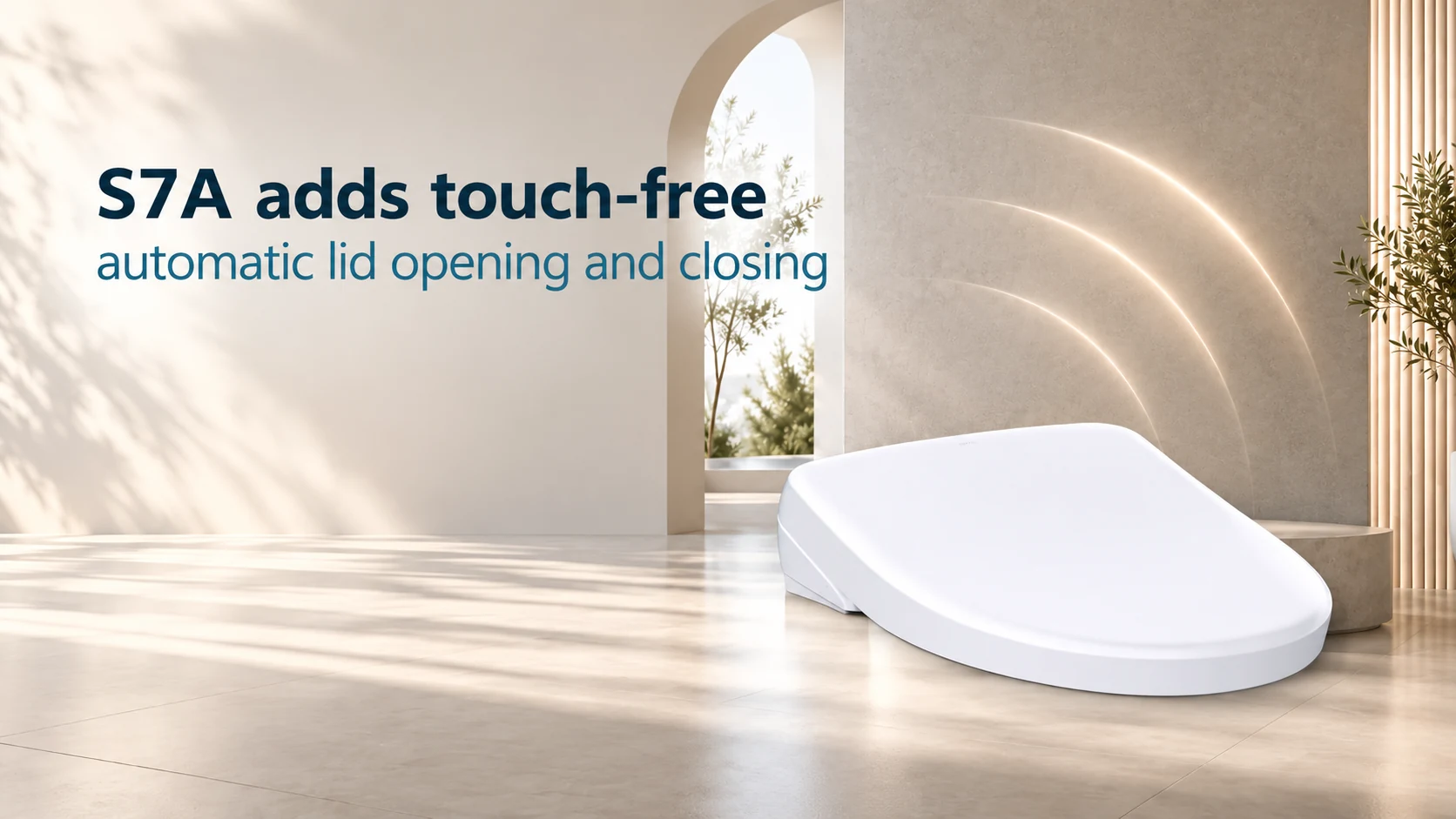
The S7A takes everything the S7 offers and adds TOTO’s automatic open and close lid. The lid lifts as you approach and closes after you leave, reducing the need to touch it. Pair the S7A with a compatible TOTO toilet and optional auto flush kit to add automatic flushing as well.

Like the S7, the S7A has Wide Front Cleanse, five temperature settings, a lower-profile design and a skin-detection sensor. It uses TOTO’s multifunction wireless remote and carries a two-year limited residential warranty. It’s available with TOTO’s flush-fitting contemporary lid or a classic lid in elongated versions, plus a round version.

Best for

Luxury ensuites, anyone who values touch-free convenience, and households with aging-in-place or mobility needs, where not having to bend down to a lid is a real benefit.

TOTO WASHLET S7A with touch-free automatic lid opening and closing

WASHLET+ and Auto Flush: Getting the Cleanest Look

All three seats fit most standard toilets, but pairing them with a WASHLET+ ready TOTO toilet takes the installation up a level. The power cord and water supply hose route through a channel under the seat, so there’s nothing visible hanging off the side of the bowl.

If auto flush is on your wish list, choose the S7 or S7A, pair it with a compatible TOTO toilet, and add the auto flush kit that matches your flush type. The S5 doesn’t support auto flush. If you’d prefer the bidet built right into the toilet, our intelligent and smart toilets collection is worth a look.

Before You Buy: Fit and Installation Tips

  • Measure your bowl: confirm whether your toilet is round or elongated. The S5, S7 and S7A are available for both bowl shapes, but model numbers differ.
  • Check the bowl shape: toilets with a pronounced “French curve” or unusual rim may not be compatible, and some one-piece toilets need verification against TOTO’s compatibility list.
  • Plan for power: every WASHLET needs a grounded GFCI outlet within reach of the cord. If there isn’t one near the toilet, have a licensed electrician add it before installation.
  • Protect the electronics: TOTO recommends a surge protector to guard against power spikes.
  • Think about remote placement: all three remotes mount on the wall and communicate by infrared, so keep a clear line to the seat.

Which TOTO WASHLET Should You Choose?

Choose the S5 if you want TOTO’s core WASHLET experience at the most accessible price. It’s a great fit for a guest bathroom or powder room.

Choose the S7 if the seat is going into your main bathroom. Wide Front Cleanse, five temperature settings, the lower-profile design, the option to add auto flush and a two-year warranty make it the best all-round choice for daily use.

Choose the S7A if you want the most automated option. The automatic lid makes it ideal for a luxury ensuite and genuinely helpful for anyone with limited mobility.

Final Thoughts

There’s no wrong choice in TOTO’s S series. It comes down to how much comfort control and automation you want. The S5 delivers outstanding comfort for the money, the S7 is the smartest upgrade for a primary bathroom, and the S7A is the most automated of the three. Whichever you choose, pairing it with a WASHLET+ ready TOTO toilet gives you the cleanest, most integrated look. If you’re not sure which model fits your toilet, our team is happy to help.

Shop TOTO WASHLET at Bliss Bath and Kitchen, with shipping across Canada.

The Best Bathroom Faucet Styles for Small Powder Rooms

A small powder room may not offer much space, but it can still make a strong design statement. Because every fixture is more visible in a compact room, choosing the right bathroom faucet can have a surprisingly large impact on the overall look and feel.

The best small powder room faucets balance style with proportion. A streamlined design can keep the vanity from feeling crowded, while a distinctive faucet can add character without taking over the room.

Whether your powder room is modern, traditional, transitional, or somewhere in between, these faucet styles can help you create a space that feels polished, functional, and thoughtfully designed.

What Makes a Faucet Work Well in a Small Powder Room?

In a compact bathroom, visual weight matters just as much as physical size.

A faucet that looks oversized can make a small vanity feel crowded. On the other hand, a faucet that is too understated may fail to complement the rest of the room.

When choosing a small bathroom faucet, look for:

  • A streamlined silhouette
  • Proportions that suit the basin
  • A design that doesn’t visually overwhelm the vanity
  • Comfortable everyday operation
  • A finish that complements the room
  • A style that works with your mirror, lighting, and hardware

The goal isn’t simply to find the smallest faucet available. It’s to find one that feels appropriately scaled to the entire vanity area.

6 Best Faucet Styles for Small Powder Rooms

Different faucet designs can create very different visual effects. These are some of the most effective options for compact powder rooms.

  1. Minimalist Single-Hole Faucets

A minimalist single-hole faucet can be an excellent choice when you want a clean, uncluttered vanity.

Its streamlined design keeps the area around the basin visually simple, which can be especially helpful when counter space is limited.

This style works particularly well with:

  • Contemporary vanities
  • Small undermount or countertop basins
  • Simple mirrors
  • Modern bathroom interiors

Look for a design with clean lines rather than unnecessary decorative details. The result is a vanity that feels organized without looking bare.

Best for: Modern and minimalist powder rooms.

  1. Wall-Mounted Faucets for a Cleaner Look

A wall-mounted faucet can give a small powder room a more open and architectural appearance.

Because the faucet is positioned on the wall rather than occupying the countertop directly, the vanity can have a cleaner visual presence.

This approach can work particularly well when the basin itself is intended to be a focal point.

A wall-mounted design may also pair beautifully with:

  • Floating vanities
  • Countertop basins
  • Statement mirrors
  • Minimalist interiors

However, it should be considered as part of the overall bathroom design rather than added as an afterthought.

Best for: Contemporary, minimalist, and design-led powder rooms.

  1. Low-Profile Faucet Designs

Sometimes the best faucets for small bathrooms are those that don’t demand attention.

A low-profile design can help create a more restrained vanity composition, particularly when the room already has a bold mirror, patterned wall treatment, or decorative lighting.

This doesn’t mean the faucet has to be plain.

A carefully designed low-profile faucet can still provide:

  • Elegant curves
  • Refined detailing
  • A distinctive finish
  • A strong design identity

Think of it as a supporting element that allows other features of the powder room to stand out.

Best for: Powder rooms with statement walls, mirrors, or lighting.

  1. Slim, Sculptural Faucets

A small powder room doesn’t necessarily mean every fixture needs to be visually simple.

A slim, sculptural faucet can become a focal point while maintaining a relatively light appearance.

Look for elegant curves, architectural angles, or distinctive spout shapes that provide personality without adding visual clutter.

This approach works particularly well when you want the faucet to function almost like a piece of décor.

The trick is balance. If the faucet is the statement piece, keep some of the surrounding elements more restrained.

Best for: Luxury, contemporary, and design-forward powder rooms.

  1. Centerset Faucets for Traditional Powder Rooms

For a traditional powder room, a centerset design can provide a neat, coordinated appearance.

Rather than focusing on the technical configuration, think about how the faucet contributes to the character of the vanity.

Classic detailing, elegant handles, and a complementary finish can work beautifully with:

  • Furniture-style vanities
  • Framed mirrors
  • Traditional lighting
  • Decorative wall treatments

The result can feel established and sophisticated without requiring a large vanity.

Best for: Traditional and classic powder rooms.

  1. Compact Two-Handle Faucets

Two-handle designs can bring a sense of traditional craftsmanship to a powder room.

They’re particularly appealing when the bathroom has a classic or heritage-inspired aesthetic and you want the faucet to contribute to that character.

Cross handles can create a more traditional appearance, while lever handles can provide a softer transitional look.

Because the faucet is more visually detailed, consider keeping other vanity elements relatively simple.

Best for: Traditional and transitional powder rooms.

How to Choose a Faucet for a Small Bathroom Sink

A faucet should look as though it belongs with the basin rather than being selected independently.

Consider the relationship between:

Faucet + Basin + Vanity + Mirror

These four elements form the visual center of most powder rooms.

A small basin generally benefits from a faucet with a proportionate appearance. A visually heavy faucet can dominate a delicate basin, while an extremely small faucet may look out of place on a larger countertop.

Match the Faucet to the Sink Style

Sink style Faucet approach
Compact undermount sink Streamlined deck-mounted faucet
Small countertop basin Simple, proportional design
Vessel basin Appropriately elevated or wall-mounted design
Traditional basin Classic faucet with refined detailing
Corner basin Design that works naturally within the compact layout

Rather than asking, “What is the smallest faucet I can buy?”, ask:

“Which faucet looks appropriately scaled to my sink and vanity?”

That small change in perspective can lead to a much better result.

Best Faucet Styles for Different Powder Room Designs

Your faucet should reinforce the style of the room rather than compete with it.

Modern Small Powder Room

For a modern powder room, consider:

  • Minimalist silhouettes
  • Simple geometric forms
  • Clean finishes
  • Single-handle designs
  • Wall-mounted options

Keep the overall composition uncluttered so the faucet and basin have room to stand out. For a modern, design-focused option, Riobel offers collections that can complement this clean aesthetic.

Traditional Powder Room

Traditional spaces can benefit from:

  • Classic handles
  • Curved spouts
  • Detailed craftsmanship
  • Warm metallic finishes
  • Furniture-style vanities

Here, the faucet can contribute significantly to the room’s personality. For refined classic and traditional styles, ROHL is another collection worth exploring.

Transitional Powder Room

Transitional bathrooms sit between traditional and contemporary styles.

  • Look for faucets with:
  • Clean but softened lines
  • Subtle detailing
  • Classic-inspired proportions
  • Contemporary finishes

This approach gives you flexibility when coordinating the faucet with different design elements. If you want a more crafted, refined feel, Perrin & Rowe can also suit a transitional or traditional powder-room design.

Luxury Powder Room

A compact room can actually be a great place to experiment with luxury finishes and statement fixtures.

Consider making the faucet one of the room’s focal points.

Pair a distinctive faucet with:

  • A decorative mirror
  • Statement lighting
  • High-quality cabinetry
  • Carefully selected hardware
  • A restrained color palette

The key is not to make every element a statement.

How Faucet Design Can Make a Small Powder Room Feel Larger

A faucet won’t physically increase the size of your bathroom, but the right design can influence how spacious the room feels.

Keep the Countertop Visually Open

Avoid selecting a faucet that appears unnecessarily bulky for the vanity.

A cleaner silhouette can make the entire sink area feel less crowded.

Create Balance With the Mirror

The mirror is often one of the largest visual elements in a powder room.

Your faucet should complement it rather than compete with it.

For example, a simple faucet can balance an ornate mirror, while a sculptural faucet may work better with a more restrained mirror.

Use the Faucet as a Controlled Accent

Small spaces don’t need lots of decorative objects.

A distinctive faucet can provide enough visual interest on its own.

This is especially useful in a powder room, where a few carefully selected elements can have more impact than a heavily decorated vanity.

Don’t Overfill the Vanity

Leave room for practical items such as hand soap without making the countertop feel crowded.

A well-proportioned faucet can help maintain a sense of visual breathing room.

Choosing a Faucet Finish for a Small Powder Room

The faucet finish should support the room’s overall design rather than being chosen in isolation.

In a compact space, the relationship between metal finishes can be especially noticeable.

You can:

  • Coordinate the faucet with cabinet hardware
  • Repeat the finish in lighting or accessories
  • Use a contrasting finish to create a focal point
  • Pair warm metals with complementary tones
  • Keep the finish consistent when you want a calmer look

For example, a darker faucet can create a striking accent against a light vanity, while a warm metallic finish can give a traditional powder room a more inviting character.

The best approach depends on the overall palette and style of the room.

How to Pair a Small Bathroom Faucet With Other Fixtures

A beautiful faucet can still feel out of place if the surrounding fixtures don’t relate to it.

Faucet and Vanity

Consider the design language of both pieces.

A highly ornate faucet may feel disconnected from an ultra-minimalist vanity, while an extremely modern faucet may not complement a traditional furniture-style cabinet.

Faucet and Mirror

Think about contrast.

A sculptural faucet can work with a simple mirror. A decorative mirror may benefit from a more understated faucet.

Faucet and Lighting

Lighting provides another opportunity to repeat the faucet’s design character or finish.

For example, coordinating metal details can help create a more intentional appearance.

Faucet and Cabinet Hardware

The faucet and cabinet hardware don’t necessarily need to be identical, but they should feel compatible.

Repeating a finish or choosing complementary tones can help unify the space.

Faucet and Accessories

Don’t overlook smaller details.

Soap dispensers, towel hardware, and other visible accessories can either reinforce the faucet’s style or make the vanity look visually inconsistent.

Designer Tips for Choosing Small Powder Room Faucets

Tip 1: Let the Basin Set the Tone

Start with the sink and vanity rather than choosing the faucet in isolation.

Tip 2: Choose One Focal Point

If you have a dramatic mirror or bold wall treatment, let the faucet play a supporting role.

If the room is otherwise simple, the faucet can become the focal point.

Tip 3: Think Beyond Physical Dimensions

A faucet’s visual weight matters too. Two fixtures with similar measurements can look completely different because of their shapes and detailing.

Tip 4: Keep the Vanity Intentional

Every visible element matters more in a compact room. Choose only what adds value to the design.

Tip 5: Consider the View From the Doorway

Powder rooms are often seen from the hallway or entrance.

Step back and consider how the faucet looks as part of the entire vanity composition.

Tip 6: Don’t Sacrifice Everyday Comfort

A faucet should look good, but it also needs to be comfortable and practical to use.

Tip 7: Use Contrast Carefully

A contrasting faucet finish can create a beautiful focal point, but repeating that finish elsewhere can make the choice feel intentional rather than random.

Small Powder Room Faucet Buying Checklist

Before choosing your faucet, ask:

Question What to consider
Does it suit the basin? Look for visual balance
Does it overwhelm the vanity? Consider overall visual weight
Does the style suit the room? Modern, traditional, transitional, or luxury
Does it work with the mirror? Create a balanced vanity composition
Does the finish complement the room? Coordinate with visible hardware
Is the countertop still practical? Leave usable space around the basin
Does it look good from the doorway? Consider the entire room, not just the vanity
Is it comfortable to use? Style should not replace functionality

Final Thoughts

The right faucet can make a small powder room feel considerably more polished.

Instead of simply choosing the smallest fixture available, think about proportion, visual weight, design style, and how the faucet relates to the rest of the vanity.

A minimalist faucet can keep a contemporary powder room feeling open. A wall-mounted design can create a clean architectural look. A traditional or sculptural faucet can become a focal point in a more decorative space.

The best small powder room faucets are those that balance practical use with the character of the room – proving that even the smallest bathroom can make a memorable design statement. If you’re planning a broader bathroom renovation, Beck Design Build provides design and construction services that can help coordinate the wider project.

Bathroom Faucet Buying Guide: Types, Sizes, Finishes & Features

#image_title

Choosing a bathroom faucet is about more than picking a finish you like. The right faucet needs to fit your sink, work with your plumbing, provide the right amount of clearance, and suit how you use the bathroom.

Whether you’re replacing an existing faucet or designing a new bathroom, understanding bathroom faucet types, sizes, and features can help you avoid compatibility issues and choose a fixture you’ll be happy with for years.

This bathroom faucet buying guide covers the key things to consider before you buy, from mounting styles and dimensions to handles, finishes, water-saving features, and installation.

How to Choose the Right Bathroom Faucet

Start with function and compatibility, then narrow down your choices based on style.

Before choosing a faucet, consider these factors:

What to check Why it matters
Faucet type Determines how the faucet mounts and how it operates
Number of sink holes Your faucet needs to match the existing configuration
Faucet height Ensures adequate clearance above the sink
Spout reach Helps the water land in the right part of the basin
Finish Affects the overall appearance and maintenance
Handle style Determines how the faucet is operated
Water pressure Some faucets may require specific pressure conditions
Features Can improve convenience, efficiency, or accessibility
Installation Some configurations require more plumbing work

Tip: If you’re replacing a faucet, measure your existing setup before shopping. The number and spacing of holes can immediately narrow down which faucets will work.

Bathroom Faucet Types

One of the first decisions is choosing the right faucet configuration. Different bathroom faucet types are designed for different sinks, countertops, and bathroom layouts.

Single-Hole Bathroom Faucets

A single-hole faucet combines the spout and controls into one compact unit and installs through a single opening.

Best for:

  • Modern bathrooms
  • Small vanities
  • Compact powder rooms
  • Sinks with one faucet hole

Single-hole faucets are popular because they have a clean appearance and generally require less counter space.

They are especially convenient when paired with a single-handle design, allowing you to control water flow and temperature with one lever.

Centerset Bathroom Faucets

Centerset faucets are designed for sinks or countertops with three holes arranged closely together. The spout and handles are typically mounted on a shared base.

Best for:

  • Standard bathroom vanities
  • Traditional and transitional bathrooms
  • Compact countertop layouts

Centerset designs can be a practical choice when replacing an existing three-hole faucet because they can work with the existing configuration.

Always check the manufacturer’s specifications before buying, as dimensions and mounting requirements can vary between models.

Widespread Bathroom Faucets

Widespread faucets have separate hot and cold handles and a separate spout. The components are installed individually, giving you more flexibility over their placement.

Best for:

  • Larger bathroom vanities
  • Traditional or luxury bathrooms
  • Custom countertop installations
  • Homeowners who want a more spacious, decorative appearance

Because the components are separate, widespread faucets can create a more customized look than compact faucet configurations.

For example, Bliss Bath & Kitchen carries a range of premium widespread designs, including options from ROHL and Perrin & Rowe.

Wall-Mount Bathroom Faucets

Wall-mounted faucets are installed into the wall rather than directly onto the sink or countertop.

They can create a clean, minimalist appearance and are particularly useful with certain vessel or countertop sink designs.

Before choosing one, check:

  • Wall plumbing requirements
  • Faucet spout reach
  • Installation height
  • Sink dimensions
  • Water flow position

Wall-mounted faucets generally require more planning than deck-mounted models because the plumbing connections are located behind the finished wall.

Vessel Sink Faucets

Vessel sinks sit above the countertop, so they typically require a taller faucet or an appropriately positioned wall-mounted faucet.

The important consideration is clearance.

A faucet that is too short may not reach over the vessel. A faucet that is excessively tall or has an unsuitable spout angle may cause unnecessary splashing.

Measure the sink height and compare it with the faucet’s spout height and reach before purchasing.

Touchless Bathroom Faucets

Touchless faucets use sensors to activate water without requiring you to touch a handle.

They can be useful in busy family bathrooms, guest bathrooms, and spaces where hands-free operation is a priority.

However, consider the power requirements, sensor placement, maintenance, and installation requirements before choosing this type.

Bathroom Faucet Sizes: What You Need to Know

Faucet size isn’t simply about whether a faucet looks “big” or “small.” The dimensions need to work with your sink and countertop.

The most important measurements are:

  • Faucet height
  • Spout height
  • Spout reach
  • Faucet width
  • Hole spacing
  • Clearance around the sink

Faucet Height

Faucet height is the overall vertical dimension of the faucet.

A taller faucet can work well with a vessel sink, while a lower-profile faucet may be better suited to a conventional undermount or drop-in basin.

Don’t choose based on height alone. Consider how the faucet’s spout lines up with the basin.

Spout Reach

Spout reach refers to how far the spout extends over the sink.

Ideally, the water should fall comfortably inside the basin rather than too close to the front, back, or side.

A faucet with too much reach can cause water to land in an awkward position. Too little reach may make the faucet uncomfortable to use.

Faucet Width

Width matters particularly when you’re working with a smaller vanity or backsplash.

Make sure handles can be operated comfortably without hitting:

  • The backsplash
  • The wall
  • A mirror
  • Cabinets
  • Other bathroom fixtures

Faucet Hole Spacing

Hole configuration is one of the most important compatibility checks.

Configuration Typical setup
Single-hole One opening for the faucet
Centerset Three-hole configuration with closely spaced components
Widespread Separate spout and handles with wider spacing
Wall-mounted Faucet attaches to the wall rather than the sink deck

Always check the actual manufacturer’s dimensions. Terms such as “centerset” or “widespread” describe common configurations, but individual models can have different specifications.

How to Measure for a Bathroom Faucet

Replacing a faucet? Take a few measurements before ordering.

Step 1: Check the Number of Holes

Look underneath or behind your existing faucet to determine whether your sink or countertop has one, two, or three faucet openings.

Step 2: Measure Hole Spacing

For a multi-hole installation, measure from the center of one hole to the center of the other.

Don’t assume that a new faucet will fit simply because it has the same number of holes.

Step 3: Measure Faucet Height

Measure the available space above the sink, especially if you have:

  • A mirror
  • Shelving
  • A medicine cabinet
  • A backsplash
  • A window

Step 4: Measure Spout Reach

Check the distance from the faucet mounting point to the location where water exits the spout.

The goal is to position the water stream comfortably within the basin.

Step 5: Check Clearance

Make sure the faucet handles can move freely and that the spout doesn’t interfere with the backsplash or other fixtures.

Bathroom Faucet Features to Consider

Once you’ve found a faucet that fits your sink, look at the features that affect everyday use.

Single-Handle vs. Two-Handle Faucets

Single-handle faucets use one lever to control flow and temperature.

Two-handle faucets have separate controls for hot and cold water.

Feature Single handle Two handle
Operation Simple Separate hot/cold control
Appearance Often minimalist Traditional or decorative
Space Compact Requires more space
Temperature adjustment One control Two controls
Style options Modern to transitional Traditional to modern

The better option depends on your preferences and bathroom design.

Ceramic Disc Cartridges

The cartridge is one of the internal components that controls water flow.

Ceramic disc cartridges are widely used in modern faucets and are valued for smooth operation and durability.

When comparing faucets, don’t focus only on the exterior. Internal components can have a major effect on long-term performance.

Water-Saving Features

If reducing water consumption is important to you, look for faucets designed with efficient flow rates or aerators.

An aerator mixes air with the water stream to create a comfortable flow while using less water than an unrestricted stream.

Check the manufacturer’s specifications for the faucet’s actual flow rate rather than assuming all faucets use the same amount of water.

Faucet Handles

Handle design affects both appearance and usability.

Common options include:

  • Lever handles: Simple and easy to operate
  • Cross handles: Classic and traditional
  • Knob handles: Compact and decorative
  • Sensor controls: Hands-free operation

For a busy family bathroom, a simple lever can be particularly convenient.

For a traditional bathroom, cross handles can add a more classic character.

Temperature Control Features

Some faucets offer features designed to make temperature adjustment easier or safer.

Depending on the model, these can include:

  • Temperature limiters
  • Separate temperature and flow controls
  • Thermostatic technology in related bathroom fixtures

Always check the product specifications to understand exactly what a particular faucet includes.

Easy-Clean Features

A faucet is exposed to water, soap, toothpaste, and mineral deposits every day.

Features such as easy-clean aerators and practical finishes can make maintenance easier.

However, no finish is completely maintenance-free. Follow the manufacturer’s cleaning instructions to protect the surface.

Choosing the Right Bathroom Faucet Finish

Finish is one of the easiest ways to change the look of a bathroom.

Popular options include:

Finish Design character Considerations
Chrome Clean and versatile Works with many styles
Polished nickel Warm and refined Suits traditional and transitional spaces
Brushed nickel Soft and understated Helps create a subtle look
Matte black Modern and bold Creates strong contrast
Brushed gold Warm and decorative Works well as an accent
Unlacquered brass Classic and evolving Develops a natural patina over time

Don’t choose a finish based on the faucet alone.

Consider matching or coordinating it with your:

  • Shower fixtures
  • Cabinet hardware
  • Towel bars
  • Lighting
  • Door hardware
  • Other bathroom accessories

For shoppers looking for premium finish options, brands such as Riobel offer bathroom faucet designs across a range of styles and finishes. Bliss Bath & Kitchen’s Riobel selection includes single-hole and wall-mount options among its bathroom faucet offerings.

Bathroom Faucet Installation: What to Check Before Buying

The easiest faucet to install is usually one that matches your existing sink and plumbing configuration.

Before ordering, check:

  1. Number of faucet holes
  2. Hole spacing
  3. Supply connections
  4. Countertop thickness
  5. Faucet dimensions
  6. Water pressure requirements
  7. Manufacturer installation requirements

Wall-mounted faucets can require additional planning because plumbing is installed inside the wall.

If you’re doing a renovation, it’s best to select the faucet before finalizing the plumbing rough-in.

For plumbing work, follow local requirements and use a qualified professional where necessary. Bunnings and other bathroom guidance sources similarly recommend considering existing plumbing, installation location, and water pressure when selecting bathroom tapware.

How Much Should You Spend on a Bathroom Faucet?

Bathroom faucets are available at a wide range of price points.

Instead of choosing purely by price, consider what you’re getting for the money.

Budget Faucets

Usually focus on basic functionality and simple designs.

Mid-Range Faucets

Often provide more choices in:

  • Design
  • Finish
  • Handle configuration
  • Internal components
  • Warranty coverage

Premium Faucets

Premium faucets may emphasize:

  • Refined design
  • Specialty finishes
  • Materials and construction
  • Detailed engineering
  • Brand heritage
  • Longer-term support and warranty

The most expensive faucet isn’t automatically the best choice. The right faucet is one that fits your sink, meets your needs, and provides the features and quality you value.

Common Bathroom Faucet Buying Mistakes

1. Buying Before Measuring

A beautiful faucet is useless if it doesn’t fit your sink.

2. Ignoring Hole Configuration

Always check whether you need a single-hole, centerset, widespread, or wall-mounted faucet.

3. Choosing the Wrong Spout Reach

The water should land comfortably inside the basin.

4. Choosing Height Based Only on Appearance

A tall faucet isn’t automatically better. Make sure it works with your sink and surrounding space.

5. Choosing a Finish Without Considering the Rest of the Bathroom

Coordinate the faucet with other hardware for a more cohesive design.

6. Forgetting Water Pressure

Check the faucet’s requirements against your home’s plumbing system.

7. Focusing Only on Exterior Design

Look at the internal cartridge, flow rate, warranty, installation requirements, and overall specifications too.

Bathroom Faucet Buying Checklist

Before you click Buy, run through this checklist:

Fit

  • Number of holes checked
  • Hole spacing measured
  • Faucet height checked
  • Spout reach checked
  • Sink clearance confirmed

Function

  • Single or two handles selected
  • Water flow requirements checked
  • Desired features identified
  • Water-saving options considered

Style

  • Finish selected
  • Faucet style matches the bathroom
  • Finish coordinates with other fixtures

Installation

  • Plumbing compatibility checked
  • Installation requirements reviewed
  • Professional installation considered if required

Long-term value

  • Cartridge/component quality checked
  • Warranty reviewed
  • Cleaning requirements understood

Bathroom Fixtures Buying Guide: How to Choose Faucets, Vanities & Accessories That Last

Quick answer: The right bathroom fixtures come down to three decisions — matching your finish across all pieces, sizing your vanity to your actual floor space, and buying from brands that back their finishes with a real warranty. Shop the categories below, or call our product experts at 1-855-366-1001 for a free recommendation matched to your space and budget.

Renovating a bathroom involves dozens of small purchasing decisions — and each one affects how the finished room looks, functions, and holds its value. This guide walks through how to choose bathroom faucets, vanities, LED mirrors, and accessories — with in-stock picks you can add to cart today, backed by free shipping across Canada and the USA on items under 70 lbs.

1. Start With a Finish, Not a Product

Before choosing individual fixtures, pick one hardware finish and commit to it across the faucet, shower system, towel bars, and cabinet hardware. Mixed finishes are the single most common reason a newly renovated bathroom still looks unfinished — and the easiest, cheapest mistake to avoid before you buy anything.

  • Chrome — timeless, easiest to match, most affordable, wipes clean easily
  • Brushed nickel — warmer than chrome, hides water spots better
  • Matte black — high contrast, on-trend, shows fingerprints more
  • Brushed gold / brass — a statement finish that pairs beautifully with warm wood vanities

Shop the pick: Riobel EQS01 Equinox Single Hole Bathroom Faucet

A best-selling single-hole faucet available in the finishes above, with a ceramic disc valve built for long-term reliability. $208.95 – $313.43. and add to cart →

2. Choosing a Bathroom Faucet

Bathroom faucets are sold by mounting style, which determines which vanities and sinks each one will fit — so confirm your configuration before you buy.

Faucet Type Best For Notes
Single-hole Modern, minimalist vanities Most versatile, widest selection
Centerset (4″) Standard vanity tops Handles and spout on one base
Widespread (8″) Wider vanity tops, double sinks Handles installed separately from spout
Wall-mounted Vessel sinks, floating vanities Requires rough-in plumbing behind the wall

Look for a ceramic disc valve, which resists dripping far longer than rubber-washer designs. the full bathroom faucet collection →

3. Sizing a Bathroom Vanity

Vanity size is dictated by your room, not your preference:

  • Under 30″ of wall width → wall-mounted or compact vanity, 18″–24″ wide
  • 30″–48″ of wall width → single-sink vanity, 30″–42″ wide
  • 60″+ of wall width → double-sink vanity for shared or primary bathrooms

Leave at least 15 inches of clearance between the vanity’s outer edge and any toilet, tub, or shower door. Shop bathroom vanities by size and finish → Not sure what fits? Send us your dimensions and our team will shortlist vanities that work in your space — no obligation to buy.

4. Upgrade Your Toilet While You’re At It

If you’re already replacing fixtures, a smart toilet is one of the highest-impact upgrades you can make in a single purchase — and it’s currently one of our best-value deals in-store.

Shop the deal: TOTO G5A Washlet Integrated Smart Toilet — Display Clearance

Built-in bidet, heated seat, and auto-flush in one unit. $5,364.75 now $2,624.25 while display-clearance stock lasts. View this deal → · Browse all TOTO products →

5. Lighting: LED Mirrors and Medicine Cabinets

LED mirrors solve the shadow problem that vanity light bars create by lighting your face evenly from beside or around the mirror. Look for adjustable color temperature, an anti-fog defogger, and touch or motion-sensor controls. Shop LED mirrors → If storage is tight, an LED medicine cabinet combines lighting with concealed storage in the same wall footprint.

6. Finish the Room With Coordinated Accessories and a Shower Kit

Small accessories have an outsized effect on how “finished” a bathroom looks:

Shop the pick: Riobel TKIT3023TM Shower Kit

Complete shower kit with rain showerhead and hand shower in coordinating finishes. $378.30 – $562.50. View and add to cart →

0
0
Your Cart
Your cart is emptyReturn to Shop